
Explore the Full USS Arizona Memorial Guide21 sections
- 01USS Arizona Memorial at a Glance
- 02Why the USS Arizona Memorial Matters
- 03USS Arizona Before Pearl Harbor
- 04Building a Battleship for a Changing World
- 05Launching and Commissioning USS Arizona
- 06Arizona’s Early Naval Service
- 07Modernization and the Pacific Fleet
- 08Life Aboard USS Arizona
- 09The People Behind the Uniforms
- 10December 7, 1941
- 11The Destruction of USS Arizona
- 12Courage, Survival, and Loss
- 13Why the Ship Remains in Pearl Harbor
- 14Creating the USS Arizona Memorial
- 15Architecture and Symbolism
- 16The Shrine Room
- 17The Oil That Still Rises
- 18Preserving the Ship and Memorial
- 19Little-Known Facts
- 20Frequently Asked Questions
- 21Reflection and Legacy
Discover the Story Beneath the Memorial
The USS Arizona Memorial is more than a historic structure standing above the waters of Pearl Harbor. It is a place where a ship, a memorial, and the lives of more than a thousand service members are permanently connected.
Beneath the white memorial rests USS Arizona, a United States Navy battleship destroyed during the attack on Pearl Harbor on December 7, 1941. The ship’s loss became one of the defining tragedies of that morning. Of the 2,341 American service members killed during the attack, 1,177 died aboard Arizona. The loss represented approximately half of all American fatalities at Pearl Harbor that day. (National Park Service)
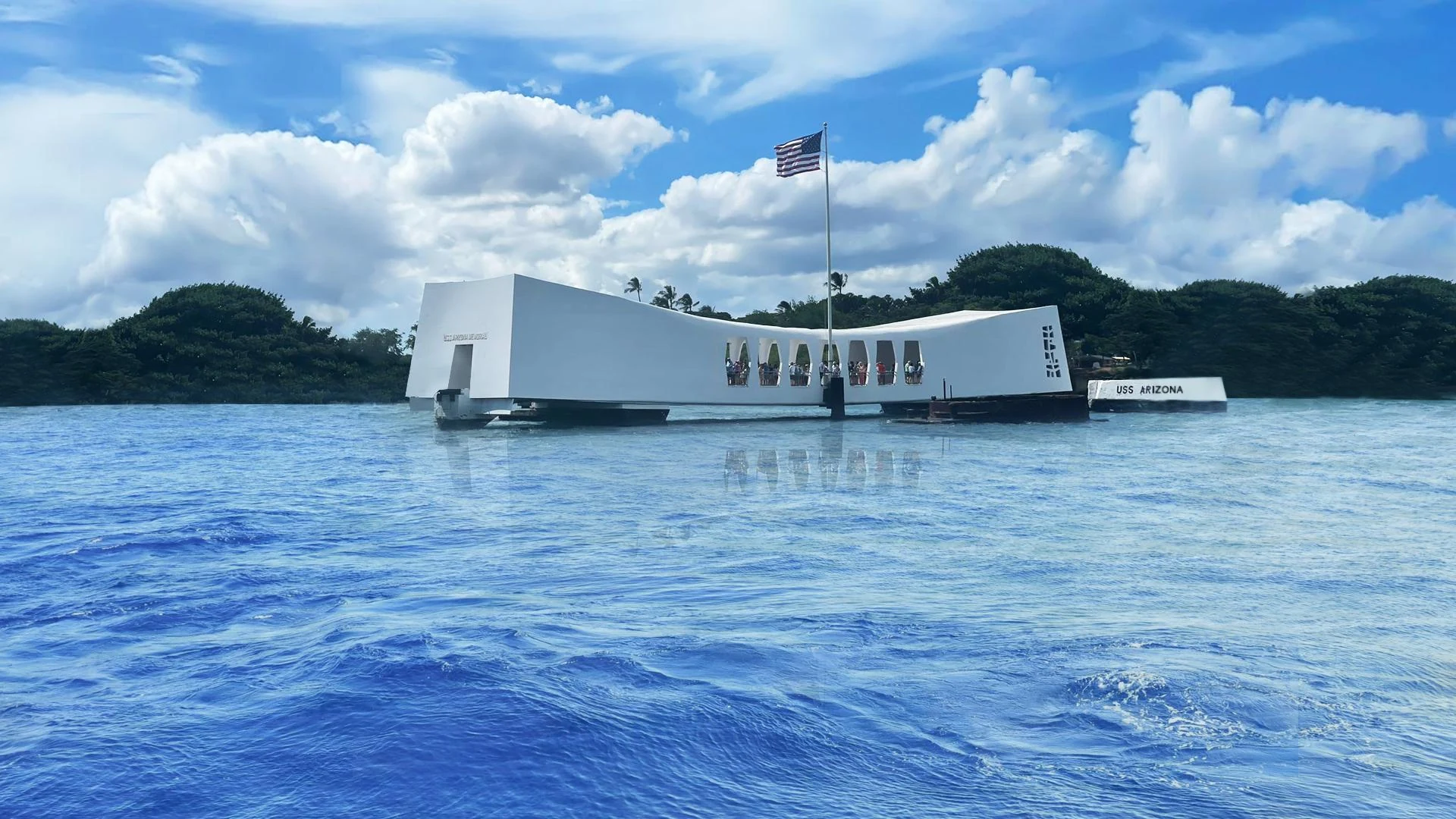
The memorial does not rest directly on the ship. Instead, it spans the sunken hull without touching it, allowing visitors to stand above the vessel while preserving the wreck as a protected historic site and the final resting place of many of those who died aboard.
For visitors, the experience is often quiet and deeply personal. Some arrive because a relative served during World War II. Others come to understand an event they first encountered in schoolbooks. Many know little about the battleship before arriving, yet leave with a stronger understanding of the people who lived and served aboard it.
This page explores the USS Arizona Memorial itself: the battleship beneath it, the men connected to it, the events that led to its destruction, the creation and symbolism of the memorial, the continuing preservation of the wreck, and the meaning the site carries today.
This is not simply the story of a ship that sank. It is the story of how a place of sudden destruction became a place of remembrance, reflection, and historical responsibility.

USS Arizona Memorial at a Glance
.jpg?width=1600)
The USS Arizona Memorial is located in Pearl Harbor on the island of Oʻahu, Hawaiʻi. It stands above the midsection of the sunken battleship USS Arizona, designated BB-39 by the United States Navy.
The battleship was commissioned on October 17, 1916. It served for approximately twenty-five years before being destroyed during the Japanese attack on Pearl Harbor on December 7, 1941. The ship suffered several bomb strikes, followed by a catastrophic explosion in its forward ammunition magazines. The blast devastated the forward part of the vessel and caused Arizona to sink at its mooring along Battleship Row. (Naval History and Heritage Command)
The memorial above the wreck was completed and dedicated in 1962. Designed by Honolulu architect Alfred Preis, the structure measures approximately 184 to 185 feet in length. It is narrowest and lowest at its center and wider and higher at both ends. The interior includes an entry area, a central assembly space, and the Shrine Room, where the names of those who died aboard Arizona are engraved. (National Park Service)
Quick Facts
- Official name
- USS Arizona Memorial
- Location
- Pearl Harbor, Oʻahu, Hawaiʻi
- Ship designation
- USS Arizona, BB-39
- Ship class
- Pennsylvania-class battleship
- Keel laid
- March 16, 1914
- Launched
- June 19, 1915
- Commissioned
- October 17, 1916
- Destroyed
- December 7, 1941
- Service members killed aboard
- 1,177
- Memorial completed
- 1962
- Architect
- Alfred Preis
- Approximate memorial length
- 184–185 feet
- Relationship to the ship
- The memorial spans the wreck but does not rest upon it
- Current stewardship
- The site is administered by the National Park Service as part of Pearl Harbor National Memorial, while the wreck remains under the jurisdiction and protection of the United States Navy. (National Park Service)
USS Arizona Timeline
March 16, 1914
Keel laid
Construction of USS Arizona began at the New York Navy Yard.
June 19, 1915
Launched
The battleship entered the water with Esther Ross serving as sponsor.
October 17, 1916
Commissioned
USS Arizona formally entered active service with the United States Navy.
1929–1931
Modernized
A major modernization changed the ship’s appearance, protection, and capabilities.
1940
Pacific Fleet base
Arizona and other Pacific Fleet battleships began operating from Pearl Harbor.
December 7, 1941
Destroyed in the attack
A bomb ignited the forward magazines, causing catastrophic loss of life.
Post-attack period
Salvage and preservation decisions
Usable equipment was recovered, but the shattered ship remained in place.
1962
Memorial dedicated
The Alfred Preis-designed memorial opened above the submerged battleship.
Today
Scientific monitoring
The wreck is studied and monitored as a protected historic site and war grave.
A Memorial, a Ship, and a Final Resting Place
The USS Arizona Memorial has three identities at the same time.
It is an architectural memorial built by the living.
It is a historic site connected to one of the most consequential events of the twentieth century.
It is also a place of burial. Many of the men who died aboard Arizona were never removed from the ship. The submerged hull therefore remains their final resting place.
Understanding these three identities changes the way the memorial is experienced. The white structure is what visitors see above the water, but the central meaning of the site lies below it.
Why the USS Arizona Memorial Matters

Some historic places are important because a famous decision was made there. Others matter because a major battle was won or a political agreement was signed. The USS Arizona Memorial holds a different kind of importance.
It marks the location of extraordinary loss.
On the morning of December 7, 1941, Pearl Harbor was attacked by aircraft launched from Japanese carriers operating north of Hawaiʻi. The assault struck American naval and military facilities across Oʻahu and propelled the United States into World War II.
USS Arizona became the most devastating single loss of the attack. At approximately 8:10 a.m., an armor-piercing bomb penetrated the ship and ignited the forward ammunition magazines. The resulting explosion tore through the battleship and killed 1,177 members of its crew. (Naval History and Heritage Command)
The number is difficult to comprehend by itself. It becomes more understandable when we remember that each person had a separate life beyond the ship.
They came from cities, farming communities, coastal towns, and small settlements throughout the United States. Some were experienced officers. Others were young enlisted sailors beginning their first years away from home. They had parents, spouses, children, siblings, plans, fears, routines, and unfinished conversations.
The memorial gives physical form to their absence.
A Place Where History Remains Present
At many historic sites, the original object or structure has disappeared. A marker tells visitors what once stood there. At the USS Arizona Memorial, the ship remains in place.
Sections of the battleship can be seen beneath the surface. Its submerged hull extends far beyond the footprint of the memorial. Oil still escapes slowly from the wreck. The ship is not a reconstruction and the memorial is not built beside an empty location. The physical evidence of the event remains below the visitor.
That closeness gives the site unusual power.
The attack is not presented only through photographs, artifacts, dates, or written accounts. Visitors stand directly above one of its central scenes.
A National Memorial with International Meaning
The USS Arizona Memorial is closely connected to American memory, but its historical meaning is international.
The attack on Pearl Harbor helped transform a war already raging across Europe, Asia, Africa, and the oceans into a truly global conflict involving the United States on an unprecedented scale. The consequences reached countries and communities far beyond Hawaiʻi.
For this reason, people from many nations visit the memorial. They may approach the history from different family experiences or national perspectives, but the site offers a shared opportunity to consider the human consequences of war.
The National Park Service describes Pearl Harbor National Memorial as a place that honors those affected by the attack and encourages reflection upon the event’s continuing global significance and the pursuit of peace. (National Park Service)
The Memorial Does Not Glorify Destruction
The strongest quality of the memorial is its restraint.
There are no enormous statues showing battle. The architecture does not attempt to recreate the explosion or overwhelm visitors with patriotic decoration. Instead, its white form crosses the ship quietly.
The central space is open to light, air, water, and the changing sky. Visitors hear voices, wind, boat movement, and harbor sounds. The design makes room for reflection instead of telling every visitor exactly what to feel.
This is important because remembrance is different from spectacle.
The USS Arizona Memorial honors military service without turning destruction into entertainment. It recognizes sacrifice without hiding the terrible cost of war. It allows patriotism, mourning, history, and reflection to occupy the same space.
A Connection Between Generations
When the memorial opened in 1962, many survivors of the attack and family members of those killed were still relatively young. Today, the distance between modern visitors and December 7, 1941, is much greater.
That makes the memorial increasingly important.
As direct personal memory disappears, physical places become guardians of public memory. They give future generations somewhere to encounter history beyond a screen or textbook.
A child visiting today may have no living relative who remembers World War II. Yet that child can look through an opening in the memorial, see the ship below, and understand that the names in the Shrine Room belonged to real people.
The architecture creates a bridge not only over the battleship, but also between generations.
USS Arizona Before Pearl Harbor
%20-%20NH%2057663.jpg?width=1600)
Before USS Arizona became permanently associated with Pearl Harbor, it was one of the most powerful battleships in the United States Navy.
The vessel belonged to the Pennsylvania class, a group that included USS Pennsylvania and USS Arizona. These ships represented an important stage in American naval development during the years before and after the First World War.
Arizona was built at the New York Navy Yard in Brooklyn. Its keel was laid on March 16, 1914, and the ship was launched on June 19, 1915. Esther Ross, the daughter of an Arizona pioneer family, served as the ship’s sponsor. Arizona entered commissioned service on October 17, 1916, under the command of Captain John D. McDonald. (Naval History and Heritage Command)
At the time, battleships were viewed as the central instruments of naval power. Their enormous guns, armor protection, and ability to operate across long distances represented national strength at sea.
What the Name “Arizona” Represented
The ship was the second United States Navy vessel named for Arizona. Naming a major battleship after a state carried symbolic importance. It connected the vessel to the people, identity, and public pride of that state.
Although the battleship was built in New York and served across several regions, its name created a lasting relationship with Arizona. Citizens of the state followed the vessel’s career, contributed ceremonial objects, and later played an important role in supporting efforts to create a permanent memorial.
The name also humanized the ship. To sailors, newspapers, Navy families, and the public, it was not merely BB-39. It was Arizona.
A Ship Designed for Heavy Combat
USS Arizona was constructed during a period when naval planners expected future wars to be decided partly through confrontations between heavily armed fleets.
The battleship displaced more than 31,000 tons in its later configuration and carried twelve 14-inch guns arranged in four triple-gun turrets. These massive weapons were designed to strike enemy ships at long range. The vessel also carried smaller guns for defense against other threats.
Its hull was protected by heavy armor, especially around vital machinery, ammunition storage, and command areas. Powerful engines drove the ship through the water, while a large crew operated its weapons, boilers, communications systems, navigation equipment, and countless mechanical spaces.
To a person standing beside it, Arizona would have appeared less like a normal ship and more like a moving industrial city.
Its steel structure contained sleeping compartments, kitchens, storerooms, workshops, medical facilities, offices, gun rooms, engine spaces, electrical systems, ammunition handling areas, and passageways extending through multiple decks.
The Meaning of “BB-39”
The designation BB-39 identifies Arizona as the thirty-ninth battleship in the United States Navy’s numbered system.
“BB” became the Navy’s standard hull classification symbol for battleships. The number distinguished Arizona from every other vessel.
This designation continues to be important to historians, archivists, archaeologists, and preservation teams because it identifies not simply the ship’s name but its exact place in the Navy’s official records.
Building a Battleship for a Changing World

When construction began in 1914, the world was entering a period of rapid military and technological change.
The First World War began in Europe only months after Arizona’s keel was laid. Naval warfare was evolving through developments in gunnery, armor, propulsion, submarines, mines, communications, and aviation.
Arizona reflected the military thinking of its era. It was built to survive punishment from enemy guns while delivering tremendous firepower in return.
The Scale of Construction
Building a battleship required extraordinary coordination.
Steel plates had to be shaped and joined into a hull capable of supporting enormous weight. Engines, boilers, shafts, propellers, gun turrets, magazines, electrical systems, pumps, ventilation equipment, and communication networks all had to function as parts of one integrated vessel.
Thousands of individual components were assembled by shipyard workers representing numerous trades. Welders, riveters, machinists, electricians, pipefitters, engineers, draftsmen, crane operators, and laborers contributed to the project.
The construction process demonstrates that a battleship was never only a military object. It was also a national industrial achievement involving human skill, engineering knowledge, resources, and public financing on a massive scale.
Armor and Protection
Battleship armor was not applied equally across the entire vessel.
Naval designers concentrated the heaviest protection around areas considered essential to survival: ammunition magazines, propulsion machinery, command positions, and gun systems. Other sections received less protection to prevent the ship from becoming impossibly heavy.
This design philosophy is often described as protecting the vessel’s vital core.
Yet no armor system could provide complete safety. Weapons improved, aircraft became more capable, and bombs could strike from above where protection was sometimes more limited than along the sides.
Arizona’s destruction in 1941 would reveal how rapidly the balance of naval warfare had changed.
The Main Battery
The ship’s most visible weapons were its twelve 14-inch guns.
They were grouped into four armored turrets, with three guns in each turret. Two turrets were positioned toward the bow and two toward the stern.
Each gun could fire an extremely heavy shell across a considerable distance. Operating them required teams of sailors working through a complex chain of loading, aiming, communication, and firing procedures.
A turret was not simply a rotating platform. It extended below the visible deck into working spaces where ammunition and powder were moved upward from protected storage areas.
This relationship between guns and magazines was essential to the ship’s fighting power—but it also created a grave danger. Ammunition magazines contained large quantities of explosive material. If fire or a weapon reached them, the consequences could be catastrophic.
That is what occurred aboard Arizona on December 7, 1941.
A Battleship Built Before Air Power Dominated
When Arizona was designed, military aircraft were still relatively new. Battleships were expected to confront other battleships, and planners placed enormous confidence in armor, large guns, and fleet formations.
By 1941, naval aviation had advanced dramatically.
Carrier-launched aircraft could cross long distances, attack from several directions, and deliver torpedoes or bombs against ships that never had an opportunity to fire their main guns at an enemy fleet.
The attack on Pearl Harbor became one of the clearest demonstrations that the aircraft carrier and naval aircraft had changed warfare at sea.
Launching and Commissioning USS Arizona

Launching a major warship was both an engineering milestone and a public ceremony.
On June 19, 1915, Arizona entered the water at the New York Navy Yard. Esther Ross sponsored the ship, representing the state whose name it carried. Official photographs preserve the event and the formal arrival of the sponsor. (Naval History and Heritage Command)
However, launching did not mean the ship was ready for duty.
After entering the water, Arizona required additional work. Weapons, machinery, equipment, accommodations, communication systems, and finishing elements had to be installed and tested.
The battleship was commissioned on October 17, 1916. Commissioning formally placed it into active service with the United States Navy.
From that point forward, the ship became a working military community with a captain, officers, sailors, assigned duties, operating schedules, and a place within the fleet.
The First Crew
A ship’s first crew performs a special role.
They do not simply report to an established vessel with familiar routines. They help transform newly installed machinery and empty compartments into a functioning naval command.
Equipment must be tested. Emergency procedures must be practiced. Men must learn the arrangement of passageways, machinery spaces, weapons stations, repair lockers, living compartments, and evacuation routes.
A battleship could not function through technology alone. Its effectiveness depended upon hundreds of people learning to operate as one coordinated organization.
Arizona’s Early Naval Service
%20-%20NH%2095244.jpg?width=1600)
USS Arizona entered service during the First World War, but it did not participate in the major battles of that conflict.
Oil shortages in Britain and the operational needs of the United States Navy influenced how American oil-burning battleships were used. Arizona largely remained in American waters during the war.
After the armistice, however, the battleship participated in operations connected to the return of American troops from Europe.
Its early years included training, exercises, ceremonial duties, maintenance periods, and the continuous work required to keep a large warship ready.
Training as a Permanent Mission
Much of naval life outside wartime consists of preparation.
Ships conduct gunnery practice, navigation exercises, fleet maneuvers, engineering drills, communications tests, damage-control training, and emergency rehearsals.
These activities may seem less dramatic than combat, but they determine whether a crew can respond effectively when conditions suddenly become dangerous.
For Arizona’s sailors, training was not a temporary activity between “real” assignments. Training was one of the ship’s central missions.
Service in the Atlantic, Mediterranean, and Pacific
Arizona served in Atlantic and Mediterranean areas during its earlier career. In 1921, it became based in Southern California and operated primarily with the Pacific Fleet. (Naval History and Heritage Command)
The transition reflected a growing American strategic interest in the Pacific.
During the interwar years, ships such as Arizona participated in large fleet exercises designed to test tactics, logistics, communications, and readiness across enormous distances.
These exercises were important because the Pacific is not a small operating environment. Fuel, maintenance, supply, navigation, weather, and coordination presented major challenges even in peacetime.
Ceremonial and Humanitarian Roles
Battleships also served diplomatic and ceremonial purposes.
Their presence in a harbor communicated national power, but they could also host officials, participate in public celebrations, and represent the United States during visits.
In March 1931, Arizona carried President Herbert Hoover during a voyage to Puerto Rico and the Virgin Islands. An official Navy photograph shows the ship underway with the presidential flag flying from its mainmast. (Naval History and Heritage Command)
This episode offers a reminder that Arizona’s twenty-five-year history included far more than its final morning. The ship carried presidents, trained generations of sailors, crossed oceans, represented the country, and served through decades of technological and political change.
Modernization and the Pacific Fleet
%20-%20NH%2057665.jpg?width=1600)
Between 1929 and 1931, Arizona underwent a major modernization at Norfolk Navy Yard in Virginia.
Modernization was necessary because warships could become outdated even when their hulls remained structurally useful. New weapons, aircraft threats, communications equipment, fire-control systems, and engineering developments required older battleships to be adapted.
The work altered Arizona’s appearance and capabilities.
Its superstructure was modified. Protective systems and armament were improved. The vessel emerged better equipped for the naval environment of the 1930s, although no modernization could fully anticipate every condition it would face in 1941.
After completing this work and carrying President Hoover, Arizona returned to the Pacific. (Naval History and Heritage Command)
Why the Fleet Moved to Pearl Harbor
In 1940, Arizona and other Pacific Fleet battleships began operating from Pearl Harbor rather than their previous principal base on the West Coast.
Pearl Harbor offered a strategic location in the central Pacific, but the decision also placed a large concentration of American naval power within one harbor.
Battleships were moored along the southeastern side of Ford Island in an area later remembered as Battleship Row.
Arizona was among them on the morning of December 7, 1941.
A Fleet Preparing for an Uncertain Future
By late 1941, international tensions were severe.
Japan had expanded military operations in Asia. The United States had imposed economic restrictions and was engaged in difficult diplomatic negotiations with Japan. American military leaders understood that conflict was possible, but the exact location, timing, and form of an attack remained uncertain.
The sailors aboard Arizona knew they were serving during a dangerous period. Yet daily life still required meals, maintenance, inspections, correspondence, training, worship, recreation, and sleep.
History often appears inevitable when viewed backward. For those living through it, the future was not yet known.
Life Aboard USS Arizona
.jpg?width=1600)
A battleship is often described through measurements: length, displacement, armor thickness, speed, and gun size.
Those numbers explain the machine but not the life inside it.
USS Arizona was a workplace, military command, school, home, and community. Hundreds of men lived in close quarters within its steel hull. Their days were shaped by discipline, noise, schedules, duty assignments, friendships, fatigue, and the constant presence of the sea.
Waking Inside a Steel City
Daily life began early.
Sailors woke in shared compartments, often sleeping in tightly arranged bunks or hammocks depending upon the period and location aboard ship. Privacy was limited. Personal belongings had to fit within small assigned spaces.
The movement of hundreds of men required routines. Compartments had to be cleaned, bedding secured, equipment checked, and uniforms prepared.
Orders were communicated through bells, pipes, announcements, messengers, and the chain of command.
On a vessel of Arizona’s size, the day did not begin everywhere at once. Some sailors had already completed night watches by the time others awakened. Machinery spaces, security stations, radio rooms, and essential services required continuous staffing.
Work Divided Among Specialized Teams
Every sailor belonged to a larger system.
Some worked with the main guns or secondary weapons. Others operated engines and boilers. Electricians maintained power systems. Radiomen handled communications. Signalmen transmitted visual messages. Cooks prepared meals. Medical personnel cared for illness and injury. Clerks managed records. Boatswain’s mates supervised deck work and seamanship.
The ship depended upon all of them.
A battleship could have the most powerful guns in the fleet, but it could not operate without clean water, electrical power, food preparation, ventilation, pumps, navigation, maintenance, and communication.
This interdependence shaped shipboard culture. A sailor’s assignment might appear narrow, but failure in one area could affect the entire vessel.
Meals and Mess Spaces
Feeding a large crew several times each day required industrial-scale preparation.
Food had to be stored, preserved, prepared, distributed, and cleaned up under conditions very different from a kitchen on land. Fresh supplies were valuable, but long voyages required extensive use of canned, dried, frozen, or otherwise preserved food.
Meals also provided moments of routine and social connection.
Sailors ate with members of their assigned mess groups. News, jokes, complaints, rumors, and letters from home circulated through these spaces.
The quality of food could influence morale, and skilled cooks were deeply appreciated.
Noise as a Constant Companion
A battleship was rarely silent.
Ventilation fans moved air through interior compartments. Pumps operated. Tools struck metal. Hatches opened and closed. Announcements echoed through passageways. Engines and auxiliary machinery created vibration. During gunnery exercises, the main battery produced a level of sound and force difficult to imagine from photographs.
Sailors learned to identify the normal sounds of the ship.
An unusual vibration, odor, alarm, or silence could signal a mechanical problem or emergency.
Heat and Ventilation
Serving aboard a steel vessel in warm climates presented physical challenges.
Interior compartments could become hot and uncomfortable, especially near machinery spaces. Ventilation was essential, but conditions were not comparable to modern climate-controlled environments.
The heat of Hawaiʻi, combined with metal surfaces, operating equipment, uniforms, and crowded compartments, could make duty exhausting.
Sailors working below deck might complete an entire watch without seeing daylight.
Watches and Continuous Readiness
A naval vessel operates around the clock.
The crew was divided into watch sections so that necessary positions remained staffed at all times. While some sailors slept, others stood watch on deck, monitored machinery, maintained security, or handled communications.
Watch duty demanded attention even during quiet periods.
Most hours passed without crisis. Yet the entire purpose of the watch system was to ensure that someone was ready when conditions changed.
On December 7, that change came with extraordinary speed.
Training and Drills
Fire was one of the greatest dangers aboard any ship, especially one carrying fuel, ammunition, electrical equipment, paint, and machinery.
Crews therefore trained repeatedly in firefighting, flooding control, first aid, ammunition handling, and emergency response.
Damage control depended upon immediate action. Watertight doors had to be managed. Pumps and hoses had to work. Injured people had to be moved through narrow spaces. Fires had to be contained before they reached fuel or magazines.
These drills built habits that later helped sailors respond under attack, even when communications failed and familiar spaces became filled with smoke, flame, wreckage, and water.
The People Behind the Uniforms
%20-%20NH%2086101.jpg?width=1600)
The crew of USS Arizona was not a single, uniform group.
Its members came from different states, communities, economic backgrounds, ethnicities, religions, and family circumstances. They held different ranks and responsibilities. Some had made the Navy their career. Others had joined recently.
They were united by the ship, but each carried a separate story aboard it.
Young Men Far from Home
Many enlisted sailors were very young.
For some, the Navy offered training, steady income, travel, structure, or an escape from limited opportunities during the final years of the Great Depression.
Hawaiʻi may have seemed distant and extraordinary to sailors raised in inland towns. Letters home described weather, duties, shipmates, local scenery, frustrations, and hopes for future leave.
The men aboard Arizona did not think of themselves only as historical figures. They were living ordinary lives inside an extraordinary machine.
They borrowed money, misplaced belongings, waited for mail, argued, laughed, worried about inspections, planned weekends, and counted the days until they might return home.
Officers and Responsibility
Officers carried responsibility for navigation, engineering, weapons, discipline, administration, training, and the welfare of the crew.
The captain stood at the top of the ship’s command structure, but the functioning of the vessel depended upon many levels of leadership.
Junior officers learned through experience. Chief petty officers provided technical knowledge and continuity. Petty officers supervised daily work. Experienced enlisted sailors taught newer crew members how tasks were actually performed.
The ship’s organization was hierarchical, but its survival depended upon cooperation.
Brothers Serving Together
One of the most painful dimensions of the Arizona story is that members of the same family sometimes served aboard the ship together.
During that period, the Navy allowed brothers to serve on the same vessel. For families, this could offer comfort: relatives could look after one another far from home.
But when a ship suffered catastrophic loss, one family could lose multiple sons at once.
The destruction of Arizona affected hundreds of families, and for some, grief arrived more than once in the same telegram or official notification.
The Ship’s Band
Members of Arizona’s band were trained musicians and active-duty sailors.
On the morning of the attack, band members were preparing to participate in the daily flag-raising ceremony and a scheduled music competition. Their role reminds us that military life included ceremony, music, competition, and community—not only weapons and drills.
The entire band was lost in the attack.
Chaplain Thomas Kirkpatrick
The ship’s chaplain served the spiritual and emotional needs of crew members from different backgrounds.
Chaplains conducted worship, counseled sailors, supported families, and helped men cope with fear, loneliness, grief, and moral uncertainty.
Lieutenant Commander Thomas L. Kirkpatrick, Arizona’s chaplain, died aboard the ship.
His presence in the crew list is a reminder that the battleship contained not only weapons and machinery but also spaces for worship, guidance, and human care.
Rear Admiral Isaac C. Kidd
Rear Admiral Isaac C. Kidd was aboard Arizona as commander of Battleship Division One.
When the attack began, he moved toward the bridge and his command responsibilities. He was killed during the explosion and was posthumously awarded the Medal of Honor.
His body was not recovered.
Captain Franklin Van Valkenburgh
Captain Franklin Van Valkenburgh commanded USS Arizona.
During the attack, he remained at his station as the ship came under fire. He was also killed and posthumously awarded the Medal of Honor.
The deaths of the ship’s captain, the embarked admiral, and so many members of the command structure demonstrate the speed and violence of the destruction.
Names, Not Numbers
It is necessary to use numbers when explaining the scale of the loss, but numbers alone can create distance.
“1,177” is a historical fact.
The Shrine Room transforms that number into names.
Each name represents a voice once heard aboard the ship, a specific duty station, a family connection, and a future that ended on December 7.
When visitors stand before the wall, the size of the loss becomes visible in a different way. The names fill the surface. They cannot be absorbed at a glance.
That is part of the memorial’s purpose.
December 7, 1941: The Morning That Changed Pearl Harbor
.jpg?width=1600)
On the morning of December 7, 1941, Pearl Harbor appeared much like any other Sunday morning. The harbor was quiet, many sailors were preparing for breakfast, others were finishing overnight watch, and some were looking forward to shore leave later that day. Few could have imagined that within minutes the United States would suffer one of the most devastating military attacks in its history.
The Pacific Fleet lay at anchor throughout Pearl Harbor. Battleships, cruisers, destroyers, support vessels, and numerous other naval ships occupied their assigned positions. On Ford Island, aircraft rested on nearby military airfields, while military personnel across Oʻahu carried out their normal weekend routines.
USS Arizona occupied her berth along the southeastern side of Ford Island on what later became known around the world as Battleship Row. Moored just ahead was USS Nevada, while USS West Virginia, USS Tennessee, USS Maryland, USS Oklahoma, and USS California lay nearby. The concentration of major battleships reflected the importance of Pearl Harbor as the principal base of the U.S. Pacific Fleet.
The officers and crew aboard Arizona had no warning that enemy aircraft were already approaching the Hawaiian Islands.
The Final Hours Before the Attack
The evening of December 6 passed routinely aboard the battleship. Watch rotations continued through the night, engineering crews maintained essential machinery, and communications personnel monitored their assigned duties. Like every naval vessel, Arizona never truly slept. Even while much of the crew rested, others remained awake to ensure the ship's security and readiness.
Some sailors wrote letters home before turning in for the night. Others read books, played cards, polished uniforms, or spoke quietly with shipmates before lights-out. The routines were familiar after years of naval service.
For many aboard Arizona, December 7 began as an ordinary Sunday.
Breakfast preparations had begun before dawn. Galley crews worked below decks while cooks prepared meals for more than a thousand men. The ship's band was preparing for the morning colors ceremony. Officers reviewed schedules for inspections, religious services, maintenance assignments, and recreational activities.
Nothing aboard the ship suggested that history was only minutes away from changing forever.
Japan's Surprise Attack
Unknown to American forces in Hawaiʻi, a Japanese carrier strike force had crossed the North Pacific in complete radio silence.
Six aircraft carriers launched more than 350 aircraft in two coordinated waves. The attack force included torpedo bombers, horizontal bombers, dive bombers, and fighter aircraft. Their objective was to cripple the United States Pacific Fleet before it could interfere with Japanese military operations throughout the Pacific.
The attackers approached Oʻahu shortly after dawn.
At approximately 7:48 a.m., the first Japanese aircraft began their assault against military installations across the island. Within moments explosions erupted at Wheeler Field, Hickam Field, Ford Island, Kaneohe Naval Air Station, and Pearl Harbor itself.
The attack was carefully planned to achieve maximum surprise.
The First Signs of Danger
Many sailors aboard Arizona initially struggled to understand what they were seeing.
The first explosions echoed across the harbor, followed almost immediately by the unmistakable sound of aircraft engines diving toward their targets. Some crew members initially assumed the aircraft were participating in military exercises. Others realized almost instantly that the ships were under genuine attack.
Within seconds, anti-aircraft alarms spread throughout the harbor.
Sailors raced toward battle stations.
Officers issued emergency orders.
Watertight doors were secured.
Damage-control teams prepared for fire and flooding.
The peaceful Sunday morning disappeared almost instantly.
Arizona Comes Under Attack

Arizona quickly became one of the principal targets.
Enemy aircraft swept across Battleship Row, dropping armor-piercing bombs intended to penetrate the heavily armored decks of American battleships. Other aircraft attacked nearby vessels with torpedoes and machine-gun fire.
Crew members rushed toward anti-aircraft guns whenever possible. Others attempted to distribute ammunition, fight fires, assist wounded sailors, or prepare the ship for combat.
The attack unfolded with extraordinary speed.
Smoke already filled portions of the harbor.
Nearby ships were burning.
Columns of water erupted beside battleships as bombs and torpedoes struck.
Communication became increasingly difficult as explosions echoed throughout Pearl Harbor.
Despite the confusion, Arizona's crew responded according to their training.
The Bomb That Changed History
At approximately 8:06 to 8:10 a.m., Japanese dive bombers attacked Arizona from high altitude.
One armor-piercing bomb struck near the forward portion of the ship. After penetrating several decks, it reached the area above the forward ammunition magazines.
Seconds later, an enormous explosion ripped through the battleship.
Historians generally agree that the bomb ignited large quantities of black powder and ammunition stored within the forward magazines. The resulting detonation was catastrophic beyond anything the crew could have anticipated.
The explosion destroyed much of the forward section of the vessel almost instantly.
Massive steel plates were torn apart.
Gun turrets shifted violently.
Compartments collapsed.
Flames hundreds of feet high erupted into the air.
The blast killed hundreds of sailors before they had any opportunity to escape.
Many never knew what had happened.
A Catastrophic Explosion
Witnesses throughout Pearl Harbor later described the explosion aboard Arizona as unlike anything they had ever experienced.
A towering column of flame, smoke, burning fuel, twisted steel, and debris rose high above Battleship Row.
The force of the blast could be seen from great distances across the harbor.
Burning fragments landed on neighboring ships.
The forward superstructure disappeared within seconds beneath fire and collapsing metal.
The explosion transformed Arizona from a functioning battleship into a burning wreck almost instantly.
Nearby sailors later recalled that the sound was unlike ordinary bomb explosions. Many described it as a tremendous concussion that shook the entire harbor.
Within moments, thick black smoke covered much of the ship.
Fire Across the Harbor
The destruction of Arizona created additional dangers for neighboring vessels.
Burning fuel spread across portions of the water.
Heat from the fires complicated rescue attempts.
Smoke reduced visibility throughout Battleship Row.
Despite the danger, countless sailors from nearby ships attempted to rescue survivors whenever possible.
Some swam through burning oil.
Others maneuvered small boats toward damaged vessels while enemy aircraft continued attacking overhead.
Medical personnel established emergency treatment areas wherever space could be found.
The attack was still underway.
Yet acts of extraordinary courage were already taking place across Pearl Harbor.
Courage Under Impossible Conditions
The crew of Arizona responded with remarkable discipline despite overwhelming circumstances.
Damage-control teams attempted to contain fires wherever access remained possible.
Medical personnel treated wounded sailors amid smoke, collapsing compartments, and continuing explosions.
Officers directed rescue efforts until communication became impossible.
Enlisted sailors repeatedly exposed themselves to extreme danger while attempting to save shipmates trapped below decks.
Many acts of heroism were never fully documented because those involved did not survive.
Others were remembered only through eyewitness accounts provided by fellow sailors after the attack.
The courage displayed aboard Arizona did not prevent the ship's destruction.
It did, however, demonstrate the professionalism, dedication, and selflessness of the men who served aboard her.
The Loss of Captain Franklin Van Valkenburgh
Captain Franklin Van Valkenburgh, commanding officer of USS Arizona, remained aboard the ship during the attack while directing defensive actions.
He was last seen on the bridge carrying out his responsibilities despite the growing danger.
He did not survive the explosion.
Captain Van Valkenburgh was posthumously awarded the Medal of Honor for his leadership and devotion to duty during the attack.
His remains were never positively identified.
Today his name appears among the many honored within the Shrine Room of the memorial.
Rear Admiral Isaac C. Kidd
Rear Admiral Isaac Campbell Kidd, commander of Battleship Division One, was also aboard Arizona during the attack.
As the senior officer present, Admiral Kidd immediately assumed his wartime responsibilities while the attack unfolded around him.
He too was killed during the catastrophic explosion.
Like Captain Van Valkenburgh, Admiral Kidd received the Medal of Honor posthumously for his extraordinary leadership and courage.
He became the first U.S. Navy flag officer killed during World War II.
Hundreds Trapped Below Deck
For many crew members, escape became impossible almost immediately.
The tremendous explosion destroyed passageways, collapsed ladders, ignited intense fires, and cut off exits throughout the forward sections of the ship.
Some sailors were killed instantly.
Others became trapped beneath twisted steel as flames spread rapidly through damaged compartments.
Rescue teams worked tirelessly wherever conditions allowed, but much of the ship had become inaccessible within moments of the explosion.
The violence of the blast left little opportunity for organized evacuation from many sections of Arizona.
For hundreds of sailors, the battleship became their final resting place.
Rescue Efforts Amid Fire and Destruction
%20burning%20after%20the%20Japanese%20attack%20on%20Pearl%20Harbor%20-%20NARA%20-%20195617.jpg?width=1600)
Although the explosion aboard USS Arizona lasted only moments, the struggle to save lives continued for hours.
Survivors who managed to escape the burning ship found themselves surrounded by floating debris, burning oil, twisted steel, and thick black smoke. Many were burned while escaping through flames or jumping into the harbor. Others suffered injuries from flying debris, collapsing structures, or the blast itself.
Nearby ships immediately began rescue operations despite continuing attacks from Japanese aircraft. Small boats crossed the harbor to retrieve sailors from the water while medical personnel transformed available spaces into emergency treatment stations.
The crews of neighboring battleships and destroyers repeatedly risked their own lives to assist the wounded. Many sailors ignored their personal safety, entering dangerous areas in search of survivors.
Some rescuers later described hearing voices calling for help from damaged compartments long after the explosion. In many cases, however, the intense heat and structural collapse made rescue impossible.
Acts of extraordinary courage occurred throughout Pearl Harbor that morning, many of them never officially recorded.
The Human Cost
The destruction of USS Arizona resulted in the greatest single loss of life aboard any American ship during the attack on Pearl Harbor.
Of the approximately 1,500 men assigned to Arizona that morning, 1,177 lost their lives.
The number represented nearly half of all American military personnel killed during the attack on Pearl Harbor.
Behind every casualty stood a family waiting for letters that would never arrive.
Parents waited for sons.
Children waited for fathers.
Wives waited for husbands.
Brothers, sisters, friends, classmates, and hometown communities across America soon received official notifications informing them that their loved ones would not be returning home.
The loss extended far beyond Pearl Harbor.
Entire communities mourned together.
Newspapers across the United States published photographs of missing sailors, personal stories, and lists of the dead.
For many Americans, USS Arizona became the symbol of the attack itself.
Pearl Harbor After the Attack
%20-%20NARA%20-%20296944.jpg?width=1600)
By late morning, the attack had ended.
The harbor presented a scene almost beyond imagination.
Battleships listed heavily in the water.
Several ships had sunk.
Aircraft burned across nearby airfields.
Smoke drifted above Pearl Harbor for hours.
Emergency crews continued searching for survivors while firefighters battled stubborn blazes throughout the harbor.
Arizona continued burning for more than two days.
The tremendous heat made portions of the ship inaccessible for an extended period.
As the smoke slowly cleared, the full scale of the disaster became increasingly apparent.
America had entered World War II.
Salvage Operations
In the weeks following the attack, the United States Navy faced an enormous challenge.
Many damaged ships could potentially be repaired.
Others required extensive salvage before future decisions could be made.
Teams worked continuously to remove ammunition, recover equipment, stabilize damaged vessels, and rescue trapped personnel whenever possible.
Several battleships eventually returned to active service after remarkable repair efforts.
Arizona presented an entirely different situation.
The explosion had destroyed the forward portion of the ship with such overwhelming force that restoration became impossible.
Although some equipment and usable materials were later recovered, the battleship itself could not realistically be rebuilt.
The wreck remained where it had settled on the harbor floor.
Why USS Arizona Was Never Raised
One of the most frequently asked questions concerns why Arizona still rests beneath the waters of Pearl Harbor.
The answer combines engineering realities, historical responsibility, and human dignity.
The explosion had caused catastrophic structural damage.
Large sections of the forward hull were completely destroyed.
The internal structure had collapsed under the tremendous force generated by the exploding magazines.
Attempting to raise the wreck would have required dismantling large portions of the vessel itself.
Even if technically possible, such an operation would almost certainly have disturbed the remains of hundreds of sailors who were never recovered.
Military leaders eventually concluded that Arizona should remain where she fell.
The wreck would become both a protected historical site and a permanent military cemetery.
Today, USS Arizona is recognized as the final resting place of many members of her crew.
A Sacred Resting Place
Unlike many historic shipwrecks, USS Arizona is not simply an archaeological site.
It is also a place of burial.
For this reason, visitors are asked to behave respectfully while visiting the memorial.
Quiet conversation, thoughtful reflection, and respectful photography are encouraged.
Swimming, diving, or disturbing the wreck is strictly prohibited.
The site is protected both because of its historical importance and because it remains the resting place of American service members.
In later years, several surviving crew members chose to have their cremated remains placed within the wreck after their deaths, allowing them to reunite symbolically with the ship and the friends they served beside during World War II.
This unique tradition further strengthens the memorial's role as an active place of remembrance rather than simply a preserved historical location.
Remembering Through Preservation
During the years immediately following World War II, temporary memorials honored those who had died at Pearl Harbor.
Yet many people believed USS Arizona deserved something more permanent.
Families of those killed, veterans' organizations, military leaders, historians, and private citizens gradually joined efforts to create a lasting memorial above the wreck itself.
The challenge was extraordinary.
How could a memorial honor the dead without disturbing the ship beneath the water?
How could visitors experience the location while preserving both the wreck and its dignity?
Architects and engineers would eventually answer those questions through one of the most distinctive memorial designs in the United States.
The Vision for a Permanent Memorial
%20wreck%20in%20the%201950s.jpg?width=1600)
During the 1950s, public interest in creating a permanent memorial continued to grow.
Several proposals were discussed before agreement was reached on constructing a structure that would span the wreck without resting directly upon it.
The concept carried profound symbolic meaning.
Visitors would stand above USS Arizona while allowing the battleship itself to remain untouched below.
The memorial would connect the living with the past without physically altering the ship.
Funding came through a combination of federal support and private donations.
Public fundraising campaigns, veterans' organizations, civic groups, and individual citizens all contributed to making the project possible.
One widely remembered fundraising effort included benefit events supported by entertainer Elvis Presley, whose 1961 Pearl Harbor concert significantly increased public awareness and financial support for the memorial project.
Alfred Preis and the Memorial Design
The responsibility for designing the memorial fell to Honolulu architect Alfred Preis.
Preis developed a remarkably simple yet powerful concept.
Rather than constructing an enormous monument filled with military imagery, he designed a graceful white structure that appears to float above the battleship.
The memorial narrows gently at its center before rising again toward both ends.
Preis later explained that the design symbolizes initial defeat followed by ultimate victory.
Whether visitors immediately recognize this symbolism or simply appreciate the elegance of the structure, the architecture succeeds because it encourages reflection rather than spectacle.
The memorial does not overwhelm the visitor.
Instead, it quietly frames the history beneath it.
Building Above History
Construction required exceptional care.
Engineers could not simply build directly upon the wreck.
Instead, reinforced concrete supports were placed alongside the battleship so that the memorial could bridge across the submerged vessel without resting upon it.
This engineering solution protected the ship while allowing visitors to stand directly above its remains.
The result is unlike almost any other memorial in the world.
Visitors are not observing a reconstructed battlefield.
They are standing above the actual site where history occurred.
Every view through the memorial connects directly to the original battleship below.
That relationship between architecture and history gives the memorial much of its emotional power.
Dedication of the USS Arizona Memorial
On May 30, 1962, the completed USS Arizona Memorial was officially dedicated.
Veterans, military leaders, families, public officials, and citizens gathered to honor those who had died aboard the battleship more than twenty years earlier.
For many family members, the ceremony represented the first permanent national recognition of the sacrifice made by their loved ones.
The memorial has since welcomed millions of visitors from around the world.
School groups, veterans, historians, diplomats, military personnel, and travelers continue to cross the harbor each year to experience one of America's most important places of remembrance.
Yet despite the millions who visit, the memorial has retained the quiet dignity envisioned by its creators.
Its greatest strength lies not in its size, but in its ability to connect every visitor with the human story resting beneath the water.
Architecture and Symbolism

Few memorials in the world communicate so much through such simple architecture. The USS Arizona Memorial does not rely on towering statues, elaborate ornamentation, or dramatic military imagery. Instead, its quiet elegance allows the history beneath it to speak for itself.
Designed by Honolulu architect Alfred Preis, the memorial stretches approximately 184 feet across the submerged battleship. It rests on reinforced concrete supports positioned alongside the wreck, ensuring that the structure never touches USS Arizona itself. This engineering decision preserves the battleship while allowing visitors to stand directly above one of the most significant sites in American history.
Perhaps the most recognizable feature of the memorial is its graceful profile. The structure rises at both ends while dipping gently at its center before ascending again. Preis explained that this form symbolizes the nation's initial defeat at Pearl Harbor followed by ultimate victory during World War II.
Whether visitors recognize this symbolism immediately or simply appreciate the clean white lines of the memorial, the design creates an atmosphere of peace rather than triumph. It encourages quiet reflection instead of celebration.
Natural light, open air, and the surrounding waters of Pearl Harbor become part of the architecture itself. Visitors are constantly reminded that beneath the floor lies the actual battleship and the final resting place of many of its crew.
The Three Sections of the Memorial
The memorial consists of three principal areas, each carrying its own purpose.
The entry room welcomes visitors as they arrive by boat and introduces the historical setting.
The assembly room forms the central gathering space. Large openings along both sides allow visitors to look directly down into the harbor and observe portions of the submerged battleship beneath the clear Hawaiian water.
At the far end lies the Shrine Room, the emotional heart of the memorial.
This progression—from arrival, to observation, to remembrance—was carefully planned. Every visitor follows the same journey through the structure.
The Shrine Room

The Shrine Room contains the names of the 1,177 sailors and Marines who lost their lives aboard USS Arizona on December 7, 1941.
The names are engraved on a marble wall without distinction of rank or position. Admirals, officers, petty officers, and young enlisted sailors appear together.
This equality reflects the memorial's purpose. In death, every individual receives the same respect.
Many visitors spend the greatest amount of time in this room.
Some search for family names.
Others quietly read through the long list.
Many simply stand in silence.
Although photography is permitted, conversations naturally become softer here. The atmosphere reminds visitors that this is not only a memorial—it is also a military cemetery.
The Flag Above Arizona
One of the most recognizable features of the memorial is the American flag flying above the battleship.
The flag serves as a visible reminder that USS Arizona remains a commissioned military vessel in memory, permanently connected to the service and sacrifice of her crew.
Every day, the flag rises above the harbor where the battleship rests beneath the water.
Its presence symbolizes continuity between past and present, honoring those who served while reminding future generations of the responsibilities that accompany freedom.
The Oil That Still Rises

Visitors often notice small droplets of dark oil rising slowly from beneath the memorial.
These droplets come from fuel that remains trapped inside portions of USS Arizona more than eighty years after the attack.
The phenomenon has become known by several names, including "The Tears of the Arizona" and "The Black Tears of the Arizona."
For many visitors, watching the oil slowly reach the surface becomes one of the most emotional moments of the visit.
Scientists estimate that significant quantities of fuel remain sealed within the wreck. Modern monitoring programs carefully observe the condition of the ship to protect both the memorial and the surrounding marine environment.
Although the oil has become symbolic, preservation specialists continually evaluate the wreck to ensure that any future environmental risks can be managed responsibly.
Preserving USS Arizona
Preserving USS Arizona presents extraordinary challenges.
Unlike a museum artifact displayed indoors, the battleship remains underwater in an active harbor. Saltwater, marine organisms, corrosion, and the natural aging of steel continuously affect the wreck.
Engineers, archaeologists, marine scientists, and the United States Navy work together with the National Park Service to monitor the ship's condition.
Advanced technologies—including underwater imaging, structural surveys, remotely operated vehicles, and corrosion studies—help experts understand how the wreck changes over time.
The goal is not to restore USS Arizona to its original appearance.
Instead, preservation focuses on protecting the ship exactly as it exists today while respecting its role as a war grave.
Little-Known Facts About USS Arizona
Fact 01
USS Arizona never fired her main guns during the attack.
The explosion occurred before the battleship had an opportunity to engage enemy aircraft with its primary armament.
Fact 02
The memorial does not sit on the battleship.
It spans the wreck without touching it.
Fact 03
More than one million people visit the memorial every year.
Visitors come from every state and from countries around the world to honor those who served.
Fact 04
Several surviving crew members chose to be reunited with their ship.
After their deaths, their cremated remains were respectfully placed within USS Arizona according to Navy procedures.
Fact 05
USS Arizona remains an active archaeological site.
Researchers continue studying the wreck to improve understanding of both naval history and long-term preservation.
Fact 06
The attack lasted less than two hours.
Although the destruction changed world history, the entire assault on Pearl Harbor occurred in a remarkably short period of time.
Fact 07
The memorial was dedicated more than twenty years after the attack.
Its creation required years of planning, fundraising, engineering, and public support.
Frequently Asked Questions
Is USS Arizona still underwater?+
Yes. The battleship remains exactly where it sank on December 7, 1941.
Does the memorial touch the ship?+
No. The memorial spans the wreck but does not rest upon it.
Why wasn't USS Arizona raised?+
The catastrophic damage made salvage impractical, and the ship remains the final resting place of many crew members.
Can visitors see the battleship?+
Yes. Portions of the ship are visible beneath the water from the memorial.
Why does oil still come from the ship?+
Fuel remains trapped inside sections of the wreck and slowly reaches the surface.
Is the memorial a cemetery?+
Yes. USS Arizona serves as the final resting place of many of the sailors and Marines who lost their lives during the attack.
Who designed the memorial?+
Honolulu architect Alfred Preis designed the memorial, which opened in 1962.
Can former crew members be buried with the ship?+
Under established Navy procedures, eligible surviving crew members who choose cremation may have their ashes placed within the battleship after death.
Reflection and Legacy

The USS Arizona Memorial is far more than a destination for visitors to Hawaiʻi.
It is a place where history remains physically present.
The white memorial stands quietly above the battleship, while beneath the water rests one of the most significant symbols of American sacrifice during World War II.
Every name engraved in the Shrine Room represents a life interrupted by the events of December 7, 1941. Every visitor who crosses the harbor becomes part of an ongoing tradition of remembrance that has continued for generations.
The memorial teaches more than military history.
It reminds us that peace should never be taken for granted.
It demonstrates the courage shown by ordinary men under extraordinary circumstances.
It illustrates how architecture, history, engineering, and memory can come together to preserve one of humanity's most important lessons.
For millions of visitors, the experience ends not with words but with silence.
Standing above USS Arizona, looking through the still waters of Pearl Harbor toward the battleship below, many discover that the most meaningful tribute is simply to remember.
Sources and Editorial Review
Historical statements in this guide are attributed within the text where provided by the source material. Image captions link to their individual rights and source records.