
Explore the Full Tree of Life Guide16 sections
- 01Tree of Life at a Glance
- 02Why Is It Called the Tree of Life?
- 03Alfred Preis: The Architect Behind the Symbol
- 04Understanding the Shape
- 05The Tree of Life and the USS Arizona Memorial
- 06Why Renewal Belongs at Pearl Harbor
- 07From Conflict Toward Reconciliation
- 08Peace Is Not the Erasure of History
- 09The Tree of Life Within the Visitor Center Experience
- 10A Place for a Meaningful Photograph
- 11What to Notice When You Stand Before It
- 12Did Alfred Preis Leave One Exact Interpretation?
- 13A Symbol Shared Across Generations
- 14The Tree of Life After Your Visit
- 15Frequently Asked Questions
- 16Final Reflection: Life Continuing Through Memory
At Pearl Harbor, much of the landscape speaks through names, ships, photographs, artifacts, and preserved places.
The Tree of Life speaks through shape.
Its branching design appears simple at first. A central form rises, divides, reconnects, and opens toward the sky. Yet within that pattern is a message especially suited to Pearl Harbor: life may be wounded, history may be marked by loss, but renewal remains possible.
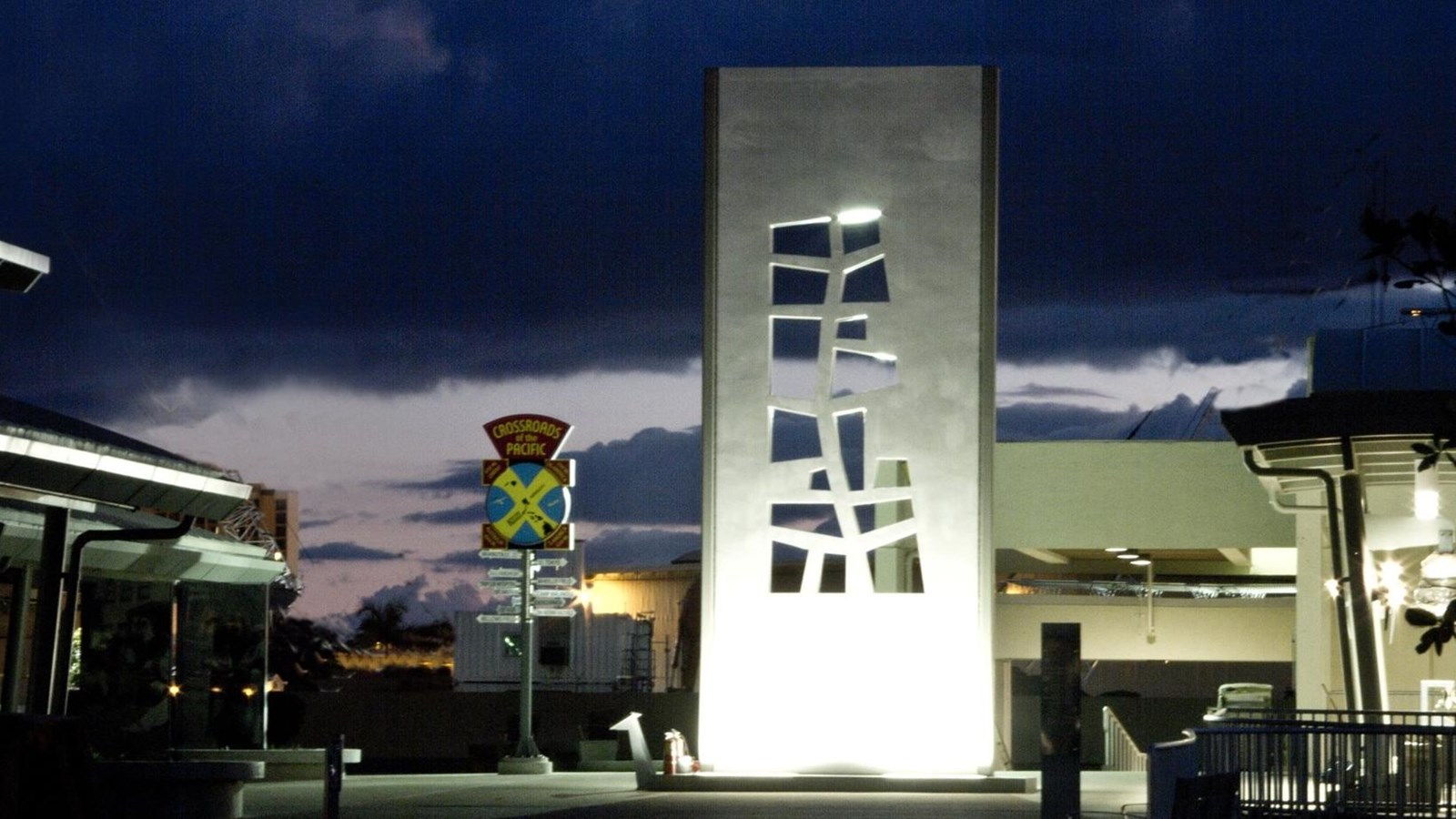
The Tree of Life sculpture at the Pearl Harbor Visitor Center was created from the same symbolic design used at the USS Arizona Memorial. Its designer, architect Alfred Preis, intended the form to inspire contemplation and represent renewal. The National Park Service officially describes the sculpture as a relief and a symbol of renewal. (National Park Service)
It is not a representation of one particular species of tree.
It has no leaves, fruit, roots, or realistic branches.
Instead, it is an abstract human interpretation of growth, connection, endurance, and continuation.
Standing near the museum and theater complex at the Pearl Harbor Visitor Center, the sculpture invites visitors to pause between experiences. They may have just learned how international tension developed before World War II. They may be preparing to enter an exhibit about the attack. They may have returned from the USS Arizona Memorial carrying emotions they cannot easily express.
The Tree of Life offers no written answer.
It offers space.
Space to remember.
Space to consider the cost of conflict.
Space to recognize that remembrance does not require humanity to remain permanently imprisoned within tragedy.
And space to imagine renewal after loss.
Tree of Life at a Glance

Tree of Life – Quick Facts
- Official name
- Tree of Life Sculpture
- Location
- Pearl Harbor Visitor Center, Pearl Harbor National Memorial, Oʻahu, Hawaiʻi
- Designer
- Alfred Preis
- Primary meaning
- Renewal
- Related memorial
- USS Arizona Memorial
- Design form
- Abstract branching relief
- Purpose
- To inspire contemplation, remembrance, peace, and the continuation of life
- Public access
- Located within the Pearl Harbor Visitor Center grounds
The sculpture is part of the broader landscape of Pearl Harbor National Memorial, where visitors learn about the December 7, 1941 attack and reflect upon its continuing historical significance and the pursuit of peace. (National Park Service)
Why Is It Called the Tree of Life?
The phrase Tree of Life appears across cultures, traditions, religions, philosophies, and artistic systems throughout human history.
Its exact interpretation varies, but several meanings frequently return:
- life continuing through generations
- the relationship among living beings
- growth from a common foundation
- survival after hardship
- the connection between earth and sky
- wisdom developed over time
- death followed by renewal
- separate lives forming part of one larger whole
At Pearl Harbor, these meanings gain additional depth.
The sculpture stands within a place defined by sudden death and continuing memory. Yet its message is not solely about the end of life. It suggests that memory can become a source of understanding and that understanding can contribute to peace.
The form rises upward.
It does not collapse toward the ground.
Its lines separate but repeatedly reconnect.
It contains openings rather than presenting a solid barrier.
Light moves through it.
The sky remains visible beyond it.
Those qualities allow the sculpture to speak without words.
Alfred Preis: The Architect Behind the Symbol

The Tree of Life cannot be fully understood without knowing something about the man who created it.
Alfred Preis was the architect of the USS Arizona Memorial. He developed an architectural language that avoided triumphalism and instead emphasized remembrance, emotional transition, and renewal.
Preis was born in Austria and later made Hawaiʻi his home. His own life had been deeply affected by war, forced migration, suspicion, and confinement. During World War II, he was interned for a period at Sand Island in Hawaiʻi because of his Austrian nationality, even though he had fled Europe. His experiences gave him a personal understanding of fear, division, displacement, and the consequences of judging people through national identity alone.
When he later designed the USS Arizona Memorial, he was not approaching the project only as an architect concerned with concrete, engineering, and appearance.
He was designing a place where grief, national memory, military sacrifice, history, and peace would meet.
The Tree of Life became one of the design’s most important symbols.
It appears within the memorial architecture and was also recreated as a separate sculpture at the Pearl Harbor Visitor Center. Pacific Historic Parks describes the motif as a universal symbol of renewal and peace and notes that the pattern appears on both sides of the USS Arizona Memorial, where it permits natural light to enter the Shrine Room. (Pacific Historic Parks Bookstore)
A Designer Who Chose Reflection Over Victory
A different architect might have filled the memorial with military symbols.
There could have been enormous anchors, weapons, eagles, flags, statues of sailors, or scenes of battle.
Preis chose restraint.
His memorial design does not recreate the explosion aboard USS Arizona.
It does not attempt to make visitors feel as though they are watching an attack.
It does not transform loss into entertainment.
Instead, the white structure passes quietly above the ship.
Openings permit air and light to enter.
Water remains visible.
The Shrine Room carries the names of those who died.
The Tree of Life gives the architecture a symbol that points beyond destruction.
That decision is fundamental to the memorial’s emotional power.
The USS Arizona Memorial remembers war, but it does not ask the visitor to worship war.
The Tree of Life honors the dead, but it does not suggest that death must have the final word.
Understanding the Shape

The Tree of Life design can be read in many ways.
There is no single compulsory interpretation, and that openness is part of its strength.
Some visitors see a tree with a strong trunk and spreading branches.
Others see human figures connected by outstretched arms.
Some see veins, arteries, roots, or flowing water.
Others notice a network: separate lines that remain connected to one larger system.
The abstract design avoids telling visitors exactly what they must think. It leaves room for personal memory.
A veteran may see fallen shipmates.
A child may see generations of one family.
A visitor from Japan may see reconciliation.
A military family may see service continuing from one generation to the next.
A person grieving a loved one may see life moving forward without forgetting what came before.
The sculpture remains the same.
The experience changes with the visitor.
The Central Trunk
The form begins with a strong central element.
A trunk traditionally represents support, continuity, and stability. It connects what lies below with what reaches upward.
At Pearl Harbor, the central form can be understood as memory itself.
Memory holds the story together.
Without memory, names become statistics.
Ships become objects.
Events become distant dates.
With memory, the past remains connected to the present.
The Branches
The branches divide outward but continue to belong to one structure.
They can symbolize individuals, families, military units, nations, or generations whose paths differ yet remain connected through history.
The attack on Pearl Harbor affected people far beyond the harbor.
Its consequences reached communities throughout the United States, Japan, Asia, the Pacific, Europe, and eventually much of the world.
The branching form reflects how one event can extend into countless lives.
The Open Spaces
The empty areas are as important as the solid material.
They permit light to move through the design.
They prevent the sculpture from becoming a wall.
They create a relationship between form and sky.
In memorial architecture, emptiness often carries meaning. It can represent absence—the people who are no longer physically present.
Yet because light passes through that absence, emptiness does not become complete darkness.
This creates one of the Tree of Life’s most beautiful ideas:
Loss creates an absence, but memory allows light to continue passing through it.
The Tree of Life and the USS Arizona Memorial

The separate sculpture at the Visitor Center is closely connected to the USS Arizona Memorial itself.
The same Tree of Life pattern appears within the memorial, where grilles beside the Shrine Room allow natural light to enter. (Pacific Historic Parks Bookstore)
This is not a decorative coincidence.
The design creates a symbolic relationship between two places:
- the Visitor Center, where people prepare to understand the history
- the memorial, where people stand above the ship and remember the dead
At the Visitor Center, the Tree of Life can be seen from a distance as a freestanding monument.
At the USS Arizona Memorial, its pattern becomes part of a more intimate space near the names of those who were lost.
The symbol therefore accompanies the visitor through the larger Pearl Harbor experience.
It appears before reflection.
It appears within remembrance.
And it remains in the visitor’s memory afterward.
Light Entering the Shrine Room
The Shrine Room is the emotional center of the USS Arizona Memorial.
Its marble wall bears the names of the 1,177 sailors and Marines killed aboard USS Arizona during the attack.
Within that space, natural light matters.
Artificial lighting could illuminate the names, but daylight connects the interior to the living world outside: the harbor, the weather, the moving clouds, the changing hours, and the passage of time.
The Tree of Life openings allow light to enter without removing the room’s solemn character.
The light is never exactly the same.
Morning light differs from afternoon light.
Cloud cover changes the tone.
The movement of the sun shifts shadows across the interior.
The names remain fixed.
The living world continues to move around them.
That relationship expresses the central meaning of renewal without requiring a written explanation.
Why Renewal Belongs at Pearl Harbor

At first, “renewal” may seem like an unexpected theme for Pearl Harbor.
The site commemorates attack, loss, destruction, and war.
Why place a symbol of new life within such a landscape?
Because remembrance has more than one purpose.
One purpose is to preserve the truth of what happened.
Another is to honor those who died.
A third is to help the living determine what should come next.
If a memorial preserves grief but offers no direction beyond grief, it may keep the past alive without helping the future.
The Tree of Life proposes that memory can lead toward responsibility.
The dead are honored not only by repeating the story of how they died, but also by learning from the world in which their deaths occurred.
Renewal does not mean forgetting.
It does not mean excusing aggression.
It does not require historical facts to be softened.
Renewal means that humanity can carry truth forward without carrying hatred forever.
From Conflict Toward Reconciliation
Pearl Harbor remains a place of American military remembrance, but over time it has also become a setting for international reflection.
Visitors arrive from Japan and from countries throughout the world.
Officials and families from nations once at war have stood together in remembrance.
The site now speaks about both sacrifice and the continuing pursuit of peace. The National Park Service explicitly frames Pearl Harbor National Memorial as a place to reflect on this shared history and its lasting significance in pursuing peace. (National Park Service)
The Tree of Life fits naturally within that mission.
A tree does not erase the ground from which it grows.
Its roots remain connected to the past.
Yet its direction is upward and outward.
Reconciliation follows a similar path.
It does not ask nations to pretend war never happened.
It asks whether truth can become the foundation for a different future.
Peace Is Not the Erasure of History
The symbol should not be misunderstood.
Peace does not require a memorial to remove painful facts.
Renewal is not denial.
The Tree of Life stands at Pearl Harbor precisely because the history is serious.
The symbol gains meaning from the loss surrounding it.
Its message is not:
“Forget what happened.”
Its message is closer to:
“Remember fully—and allow that memory to help life continue differently.”
That is a much more demanding form of remembrance.
The Tree of Life Within the Visitor Center Experience
The sculpture occupies an important place within the Pearl Harbor Visitor Center experience.
Visitors may encounter it while moving among the Road to War Museum, Attack Museum, Memorial Theater, waterfront, and other interpretive areas.
This location gives it a special role.
Museums communicate through information.
Films communicate through images and sound.
Memorial walls communicate through names.
The Tree of Life communicates through silence.
It provides a visual and emotional pause between spaces containing dense history.
A visitor may leave an exhibit after reading about failed diplomacy, military planning, the destruction of ships, or the lives of people killed during the attack.
The sculpture offers a moment to absorb that information before continuing.
Its location is therefore more than convenient.
It functions almost like punctuation within the visitor’s journey.
A Place for a Meaningful Photograph
The Tree of Life has also become one of the most recognizable photographic locations within the Pearl Harbor Visitor Center.
Visitors often stand near it for individual, family, educational-group, military, or commemorative photographs.
This is appropriate when done respectfully.
A photograph with the Tree of Life can represent more than proof that someone visited Pearl Harbor.
It can capture the relationship between remembrance and continuation.
Families may photograph several generations together.
Military groups may photograph those currently serving beneath a symbol honoring those who served before them.
Students may create a record of the day history became more real than a textbook.
The strongest photographs do not treat the sculpture as a playful background. They allow the design and its meaning to remain visible.
Photography Suggestions
For a strong photograph:
- stand far enough away to include the complete sculpture
- avoid cutting off the upper branches
- use the central trunk to frame the person or group
- visit during softer morning or late-afternoon light
- avoid blocking pathways
- allow others time for quiet reflection
- do not climb on or touch the sculpture
- keep poses respectful to the setting
What to Notice When You Stand Before It

Many visitors see the sculpture, take a photograph, and continue walking.
A slower viewing reveals more.
First, look at the balance between solid material and open space.
Then observe how many sections appear separate but reconnect.
Notice whether the design feels completely symmetrical or whether small visual differences emerge from your viewing angle.
Watch the shadows.
Move slightly to one side and see how the pattern changes against the buildings and sky.
Look through the openings rather than only at the surface.
Finally, step backward.
From a distance, the full image becomes clearer.
This change in perception reflects the way history itself is often understood.
Up close, we see individuals and details.
From farther away, we see patterns.
A complete understanding requires both.
Did Alfred Preis Leave One Exact Interpretation?
The National Park Service identifies renewal as the sculpture’s central meaning. (National Park Service)
Beyond that, the abstract design allows visitors to develop personal interpretations.
This is one reason the symbol remains powerful.
An overly literal monument can become limited to one message.
An abstract symbol can continue speaking to people whose experiences differ.
The Tree of Life belongs to Pearl Harbor’s history, but its themes—loss, survival, connection, light, growth, and peace—are universal.
A Symbol Shared Across Generations
The number of people who personally remember December 7, 1941, is rapidly diminishing.
Future generations will encounter Pearl Harbor through places, recorded voices, photographs, artifacts, family stories, and symbols.
The Tree of Life will become even more important as that transition continues.
It translates a historical lesson into a form that does not depend upon language.
A young visitor may not understand every diplomatic decision leading to the attack.
An international visitor may not read every exhibit fluently.
A person may arrive knowing very little about World War II.
Yet the image of life continuing after destruction can still be understood.
That gives the Tree of Life educational power beyond any one paragraph or historical date.
The Tree of Life After Your Visit
Some memorial symbols remain with us because they are visually simple enough to remember but meaningful enough to reconsider.
The Tree of Life is one of them.
After leaving Pearl Harbor, a visitor may recall its branching shape unexpectedly:
- when seeing a family tree,
- when watching sunlight move through leaves,
- when thinking about a relative who served,
- when reading about conflict,
- or when considering whether former enemies can become partners in peace.
This continuation beyond the physical visit is part of the sculpture’s success.
The monument remains at Pearl Harbor.
Its idea travels with the visitor.
Final Reflection: Life Continuing Through Memory
.jpg?width=1700)
The Tree of Life at Pearl Harbor does not list dates.
It does not show weapons.
It does not carry the names of the dead.
Yet it belongs deeply within the memorial landscape.
It stands for what happens after names have been read, after the history has been learned, and after the scale of loss has been understood.
Life continues.
Families continue.
Nations change.
Former enemies may meet in peace.
New generations inherit the responsibility to remember events they did not witness.
The Tree of Life does not ask visitors to move beyond the past by abandoning it.
It asks them to move forward while carrying its lessons.
Its branches rise because its foundation remains below.
Its openings admit light because the structure is not closed.
Its separate lines reconnect because history binds lives together across places and generations.
At Pearl Harbor, remembrance begins with those who were lost.
Renewal begins with what the living choose to do with their memory.